
UAE’s mobile ecosystem is shifting away from the traditional idea of an app as a digital shopfront. Mobile applications are increasingly being used by businesses to connect customers to payments, logistics, loyalty programs, internal systems and real time services. This is a different problem for an app development company, it is no longer just about building an attractive application but building a product that remains valuable after the first download.
Observing the content churned out by mobile tech organisations about the UAE, most debates are about common topics like AI, Flutter, React Native, 5G, blockchain and super applications. These technologies matter, but the larger business question typically goes unasked: How does a UAE firm select which capabilities are worth investing in, and how can those skills remain valuable as the company grows?
The UAE App Market Is Transitioning from Features to Connected Experiences
This shift is epitomised by the UAE’s payment infrastructure. Aani, the national rapid-payment platform of the United Arab Emirates, had more than 12.5 million registered users and instant transfers occurred in about three seconds, the Central Bank of the UAE said in April 2026.
For organisations, this means customers are expecting more instant and connected mobile trips. For example, e-commerce software shouldn’t think of payment as a separate final screen. The trip should include discovery of the product, identification verification, checkout, transaction confirmation, refunds and notifications.
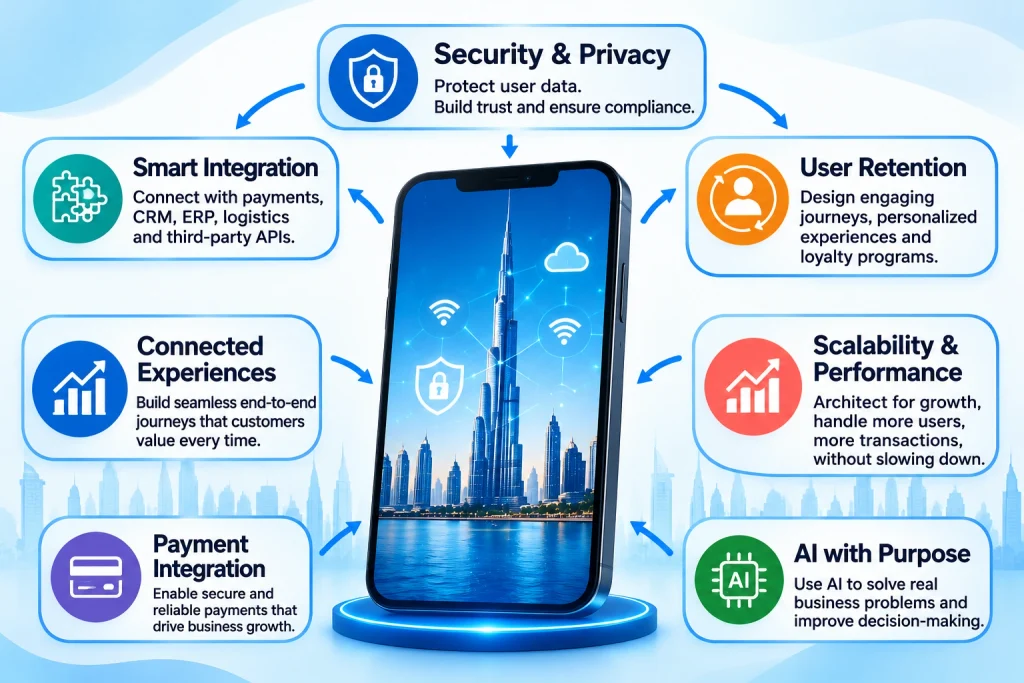
This is where an experienced mobile app development company in UAE may bring value other than coding. Before making the choice of the technologies, the developers need to map the entire journey of the customer and define where exactly the app needs to interface with payment gateways, CRM platforms, ERP systems, inventory software or third-party APIs.
The Big Question: What Happens After the Launch?
Most organisations judge an app development company by the cost of app development, delivery dates and the number of features provided in the initial release. Those factors matter, but they don’t tell you whether the application will continue to be commercially useful.
A better evaluation methodology asks five questions after launch:
- How easy is it to add new features?
- Does the back-end scale with the increasing amount of transactions?
- Can the business identify where journeys are being abandoned by users?
- How fast can security problems be recognised and resolved?
- Is the application extendable to integrate with new business systems later?
Initially, a restaurant platform might demand ordering and payment. Six months later it might need loyalty points, delivery monitoring, tailored offers and connectivity with a customer relationship management system. If the initial architecture was designed for the first version only, each addition can become costly.
A good mobile app development company in UAE should design the architecture around predicted business progression, not around today’s feature list.
AI Should Solve a Business Problem, Not Just Add a Chatbot
AI is one of the hottest themes in UAE app development content. But adding an AI chatbot alone won’t automatically make an app better.
A better approach is to find recurring decisions or encounters where artificial intelligence may create measurable benefit. For example, a property application may employ AI to enhance property recommendations based on search behaviour. A logistics app might notice strange delivery trends. Product discovery can be structured by recommendation models in a retail app.
The key difference is between AI as a feature and AI as a workflow enhancement. The app development company should also think about the type of data required for the AI function, where that data is stored, how the outputs are measured and the consequences of the model making an incorrect recommendation. Such questions are often more commercially relevant than picking the newest AI model.
Privacy Should Be Built into the Product
Security and privacy should not be considered as final stage testing tasks. UAE companies dealing with client data need to think about data security from the architecture level.
Federal Decree-Law No. 45 of 2021 on Personal Data Protection in the UAE provides protection for personal data and includes rights in relation to processing including conditions when persons may object to specific processing activities.
This is a real-world situation for an app development company in UAE. Teams should evaluate what information the application truly needs to gather and why, how long it should be stored and which systems or vendors have access to it.
For example, a fitness app doesn’t need to have constant access to your location just because the technology exists. You can also keep what you collect to a minimum . This can minimise the risk to privacy , and it can also make the product easier to understand for users.
Payment Integration Is Becoming a Strategic Asset
Another area that requires more careful preparation for UAE apps is payment capabilities. The Central Bank runs and supervises many payment systems and continues to establish a more linked digital payment ecosystem. Its objective is to increase electronic payments and promote a more cashless economy.
This means companies should look at payment architecture before they begin building. Questions need to be specific about the real payment methods clients need, how transaction failures will be handled, how refunds will function and how payment events will synchronise with order management.
In financial applications, much more attention is needed. The UAE has laws allowing the Central Bank to license and supervise some digital payment and financial services.
Therefore, finding an app development company that understands the importance of integration and regulatory issues can be more important than just choosing a vendor based on the lowest development estimate.
Digital Upward’s Place in a Connected Digital Strategy
Digital Upward is a website development business in UAE that also offers services in website building, eCommerce, mobile app development, SEO and digital marketing. Its wider service model is appropriate for firms who want their website and mobile application to be integrated elements of the same digital ecosystem, rather than separate projects.
Final Thoughts
The next phase of UAE mobile development will not be determined only by the number of applications enterprises deploy. It will be determined by how well those applications link customers, data, payments and business activities.
Hence, the finest mobile app development company in UAE is not the one that promises more features always. It is the one capable of translating a business need to a safe, quantifiable and flexible digital solution. That change from feature development to product architecture and long-term value may be the most critical decision of all for UAE companies contemplating an application in 2026.