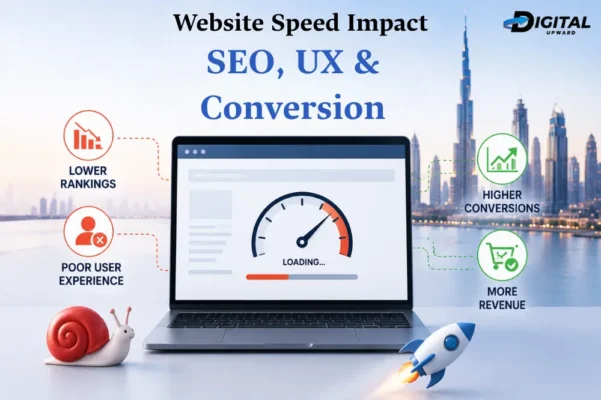
Imagine the situation where you have invested a considerable amount of your time to create a beautiful website, generate quality content, and purchase meaningful ads but still the visitors are leaving your site early without reading any words. This is exactly how a slow loading website affects your business, without any notice.
In the UAE, where smartphone penetration exceeds 97% and online shoppers expect instant digital experiences, website speed is no longer a backend concern reserved for developers. It is a front-line business issue that directly affects your Google rankings, your customer experience, and your bottom line.
This guide breaks down exactly how speed impacts each of these three areas and what you can do about it.
Why Website Speed Is a Critical SEO Ranking Factor
Google Made It Official And Non-Negotiable
Page speed became an official Google ranking signal for desktop in 2010. By 2018, it extended to mobile searches. But the real game-changer for Google was in 2021 when they decided that Core Web Vitals will be the major ranking factor. In other words, website loading speed is not just a soft signal but also a hard criteria for competition.
Fast sites will get better rankings in search engine result pages even if their content quality is not that good. Two websites covering identical topics with similar backlink profiles will not rank equally if one loads in 1.8 seconds and the other takes 5.
For any business working with a SEO company in UAE, Core Web Vitals optimization should be among the first items on the technical audit checklist because it is one of the few areas where improvements produce ranking gains relatively quickly.
Core Web Vitals: The Speed Scorecard by Google
Google uses three performance metrics to access website speed:
Largest Contentful Paint (LCP) tracks the time in which the visitor can see the largest element of your site like hero image or headline. The expected time is 2.5 seconds or faster. If we have a high LCP, it means that users are waiting to interact properly with your page.
Interaction to Next Paint (INP) is a metric data that indicates how quickly your page is responding after the user clicks, taps or types something.
It should be under 200 milliseconds. High INP makes a site feel broken, even though it doesn’t have many issues.
Cumulative Layout Shift (CLS) measures visual stability whether page elements jump around as the page loads. Target score lower than 0.1 implies that there are a lesser number of cases in which users accidentally click on a wrong element because the layout gets shifted during loading.
These three metrics are not just some numeric scores. Each of them reflects real user frustrations that Google can analyze and use to determine if your site provides a quality experience. This is why SEO experts in Dubai who understand this concept use Core Web Vitals improvements as a reliable lever for improving search visibility.
Crawl Budget: The Indexability Problem Nobody Talks About
Speed also determines how many of your pages Google actually indexes. Search engine bots operate on a crawl budget, a time allocation per site. Slow-loading pages consume a larger part of your budget because of which only a few pages get crawled and indexed by Google.
Businesses having large product catalogs or content-heavy websites can’t afford this limitation. Multiple category pages or blog posts may become invisible in search results simply because the site is too slow for bots to process efficiently.
How Website Speed Shapes User Experience
The 3-Second Threshold That Changes Everything
The data on user patience is pretty much known to all. If a page takes more than 3 seconds to load, bounce rates will increase. By 5 seconds, visitors will probably leave the site.
In the UAE, 4G and 5G connectivity is widespread and mobile browsing habits are also very intense. Users have high expectations but little tolerance for delay. A bounce is not just a lost visit. It is a signal to Google that your page failed to meet user expectations, which compounds into lower rankings over time.
Trust Is Built in Milliseconds
Users create a brand perception in their mind even before reading a single word just on the basis of user speed. A fast, responsive site communicates a sense of professionalism and reliability. A slow and fluctuating site raises unconscious doubts about security, quality, and credibility. These doubts can’t be easily reversed once they are formed.
This is especially important for businesses investing in premium ecommerce website design. A beautifully designed store will hold zero power if the experience feels unsatisfying. Design and speed are not two separate concerns, instead they must be achieved together.
How Website Speed Directly Affects Conversion Rates
Every Second Has a Price Tag
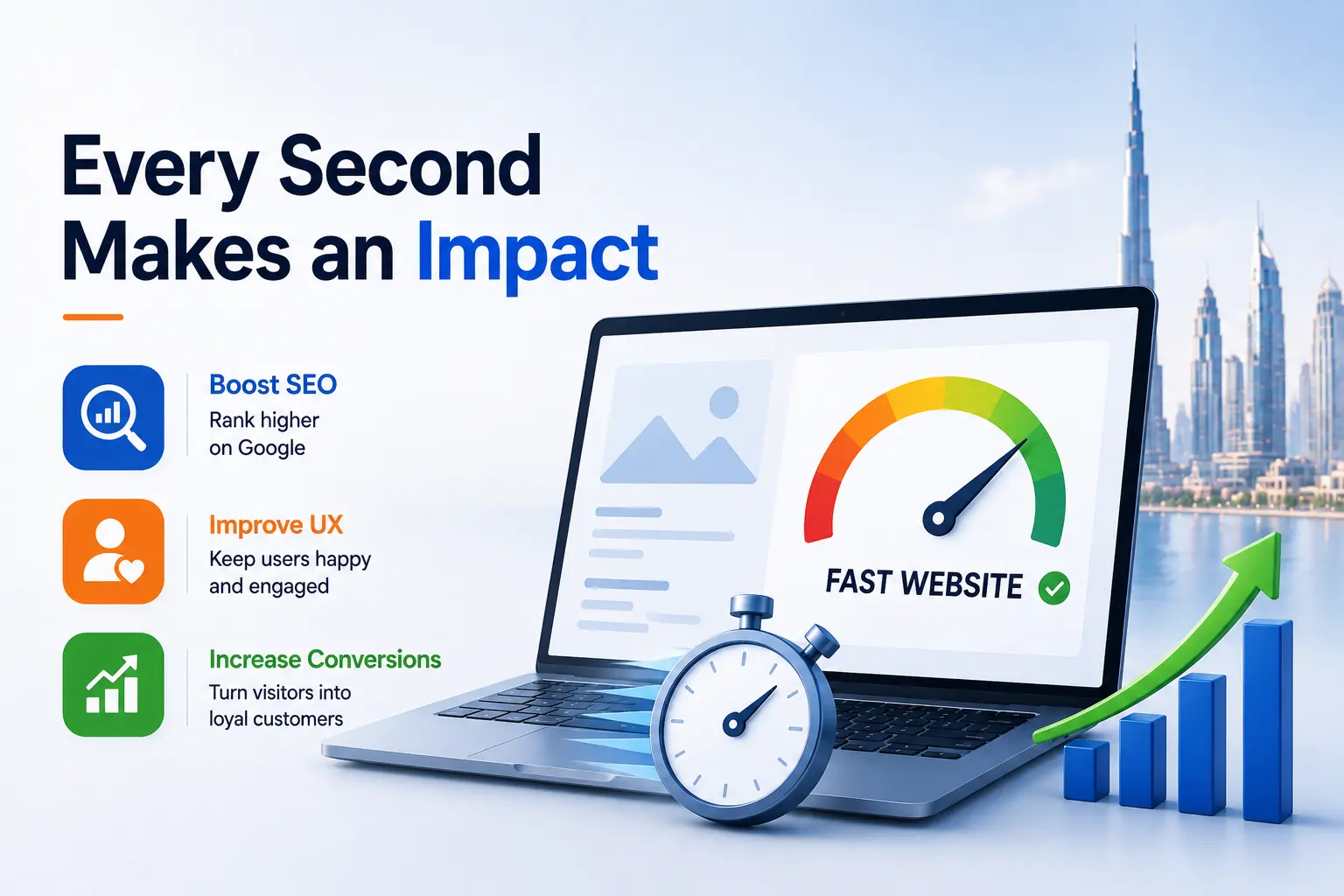
Research data has already proved that a one-second delay in page load time can lower your conversions by approximately 7%. For eCommerce businesses operating in UAE and earning around AED 200,000 per month, this one second will cost them a loss of AED 14,000 per month or over AED 168,000 per year.
Low Speed creates friction at every stage of the customer journey. When pages load instantly, users follow clear navigation, product pages will become more engaging, and they can easily process the order. High-converting stores have a smooth, uninterrupted journey making them different from the ones that look great on paper but not in practice.
High-Intent Moments Are the Most Vulnerable
Speed is the most important factor when we talk about the highest intent places of the website like product pages, checkout, and contact forms. Even a small delay at checkout makes the user doubt that if their payment will get completed, the site is secure, and whether they should continue or not.
Every website design company in Dubai that is more concerned about conversion always follows this psychology. Your website must show high-end performance at decision-making moments otherwise the conversion rate will significantly decrease.
Practical Speed Optimization Strategies
Compress and modernize the images
Images that are not optimized heavily contribute to slow loading times. Always make sure that your images are converted to WebP format and compressed before uploading to reduce the file size by up to 80% without any quality loss.
Set up browser caching
Cached storage keeps the static files stylesheets scripts images on a visitor’s device. So, users who come back experience much faster load times since the resources are not downloaded again.
Opt for the use of a content delivery network (CDN)
A CDN makes multiple copies of your website on different servers in various locations across the world. Visitors to Dubai, Abu Dhabi, or Sharjah will get the content from the server closest to them rather than a far away data center, so drastically cutting down the load time.
Minify CSS, JavaScript, and HTML
This technique involves eliminating extra characters, spaces, and comments from code files which leads to their size being reduced and while the browser parse times are improved, the functionality remains unchanged.
Pick good hosting
Inexpensive shared hosting is among the most neglected speed bottlenecks. Managed cloud hosting which is fine-tuned to your real traffic level is one of the most impactful measures you can take to improve a site’s performance.
Limit unnecessary redirects
Every redirect creates an HTTP request and adds milliseconds to your page load time. Conducting regular redirect audits will help you get rid of the hidden delays that are building up throughout your site.
How Digital Upward Helps Businesses Build Fast, Seamless Websites
At Digital Upward, we aim to build websites that will not only look attractive but also perform well to meet user expectations.
Speed is not something that can be just added once the site is developed. It depends upon each and every decision we make during design and development. Every aspect of your website needs to be optimized before launch, including server configuration, CDN setup, image delivery pipelines and code minification.
For ecommerce website design, we specifically focus on creating stores that load fast on every device and guide users towards an easy purchase journey so that more and more browsers can be converted to repeat customers, without ever compromising on visual quality or brand experience.
Ready to build a website that ranks fast, loads faster, and converts consistently? Get in touch with the Digital Upward team today.