Today many companies are fighting viciously to grab those top search rankings. But even in 2026, people are still following many outdated myths that hurt many websites. By using the wrong SEO practices, you will ultimately waste your marketing budget and bump your site down a few pages.
Understanding the fine line between what works and what merely appears good is crucial for your online success. This article lists down the top harmful SEO myths that are holding back the growth of many businesses in the UAE this year.
Myth 1: Keyword Stuffing Still Works
The most persistent on-page SEO myths since the Stone Age is that by adding your desired keyword into every sentence, you can get better rankings.
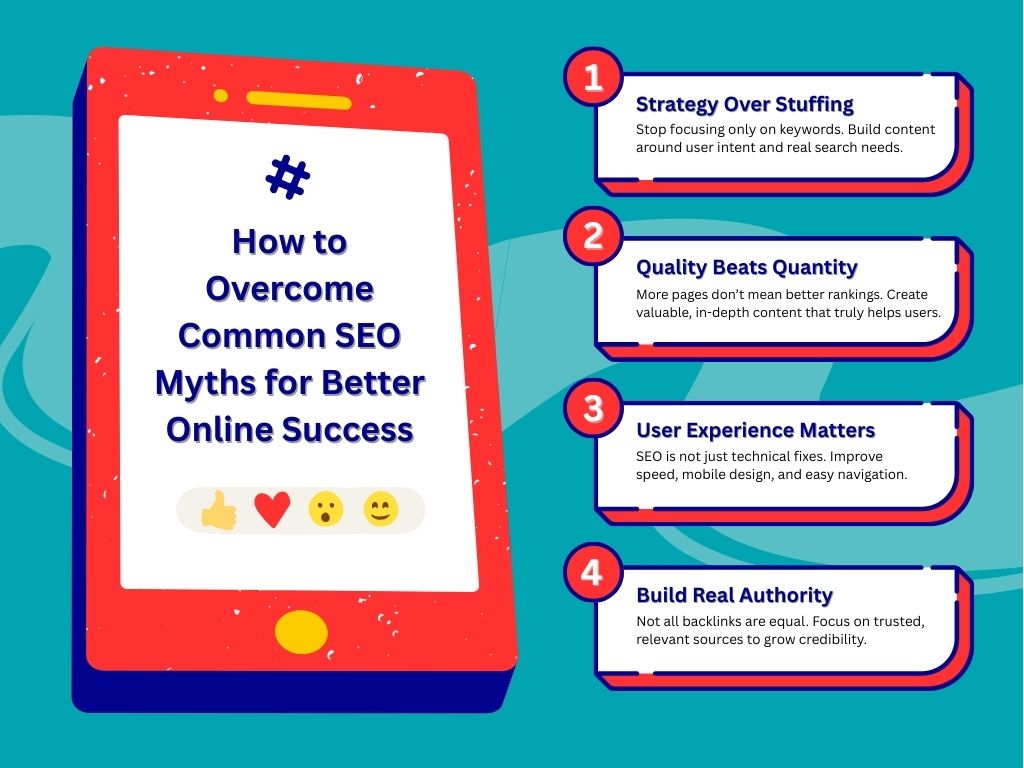
Google’s algorithms now comprehend terms in context, intent, or natural language. When you unnaturally repeat keywords, Google considers this manipulation and calls to have your site penalized.
Firstly, write naturally for humans. After that, you can think about placing your main keyword where it makes sense and adding related terms. search engine optimization agencies that have removed keyword stuffing and written more naturally have seen a dramatic increase in business volume. Understanding how to pick right SEO agency that focuses on quality content over manipulation is crucial for long-term success.
Myth 2: More Pages Always Mean Better Rankings
Some businesses think that publishing hundreds of thin, low-quality pages will make their site be seen as a bigger authority on the online platform. This sort of wrong SEO strategy usually ends up in spectacular failure.
Quality trumps quantity in the eyes of Google. Ten full-fledged pages will easily outperform a hundred superficial pages. Spend your resources on producing fewer but better pages that are genuinely useful and answer the searcher’s questions in detail.
Myth 3: Meta Keywords Still Have SEO Value
We still see webmasters trying to promote their rankings by filling up the Meta Keywords tags. But the actual fact is that Google has not used meta keywords as one of their ranking factors after 2009.
The click-through rate of your title tag and meta description is crucial. But meta keywords are meaningless. Use your precious time to bring good keywords into play for titles and descriptions that not only promote clickthroughs but also represent your content more accurately.
Myth 4: Exact Match Domains Guarantee Success
The age of buying an exact match domain to make your site rank first, like exactmatchkeyword.ae is gone. However, if you can get your keywords into the domain name, then you should. The benefits are very small, and it is not as important as it once was.
Google now ranks sites by their brand influence, quality of the content, and visitor experience. Instead of attaching too much consideration to the position of your keywords (and losing sight of the fact that the domain name is also part of your brand’s identity), choose a domain that could represent your brand identity very well and is simple enough for people to remember.
Myth 5: Social Media Shares Can Directly Increase Search Engine Rankings
People think that their Google ranking will boost up as long as they get thousands upon thousands of Facebook, Twitter, and other social media shares. Though social media can be very valuable, it’s not directly involved in the ranking of a webpage.
But social media will indirectly help in SEO. Popular content gains more visibility and achieves natural backlinks and increased brand searches, as well as traffic, all of which do influence rankings.
So use social media in a planned way to pipe up your content. Then this will not only increase the proportion of things to be shared but also make sure that people are familiar with and understand your brand.
Myth 6: Guest Posting is Dead
Some people have declared guest posting as dead after Google penalized the spammy guest posting networks. This was an overcorrection that caused companies to lose out on many valuable opportunities.
Guest posting is also effective when it is of high quality and updated on relevant and authoritative websites. Write articles based on reputable resources for multiple publications in your industry to boost authority and gain valuable backlinks. For UAE business owners, making contributions to business publications in your own community can offer lots of visibility and benefits as compared to those incorrect SEO strategies.
Myth 7: SEO Is A One-Time Task
The most destructive SEO myth is treating SEO efforts as a one-time task. Businesses invest a lot in creating a well-polished SEO strategy, see initial improvements, then neglect their site for months.
Search algorithms are constantly evolving. Competitors are updating their strategy to get better results, and users modify their behavior to something new. Something that was very effective a few months ago might be less effective today. A lot of companies that outsource their site to a reputable website design company in UAE learn this after launching great websites that lose rankings because of mere negligence.
SEO is not a “do once and forget” process. It requires consistent monitoring, regular content updates, ongoing technical maintenance, and continuing optimization.
Myth 8: More Backlinks Implies Better Ranking!
It’s a lie. Having many backlinks for a site doesn’t mean higher rankings for it. This misinformation is dangerous. Buying cheap links or taking part in link schemes can lead to a serious decline in your rankings.
When Google rates backlink quality, it looks at relevance, authority, and naturalness. One link from a respected UAE news site is worth more than a hundred links on low-quality directories.
By excelling in content and forming real partnerships, work hard to get linkbacks. Today, focus on how the best content you can produce is useful enough to be linked by others.
Myth 9: Duplicate Content Causes Penalties
There are many misunderstandings about duplicate content. Many people believe that all duplicate content brings immediate punishment. Although duplicate content isn’t a great idea, Google simply doesn’t penalize websites unless they have been created to manipulate results.
The problem arises from the fact that Google doesn’t know which version you intend to have ranked. Use canonical tags to show you prefer one version over another. In fact, the biggest concern for most businesses is that the search engine spends time crawling things it doesn’t need to, rather than actually penalizing anything directly at present.
Myth 10: Longer Content Ranks Better
A “more is better” mentality has led to extraordinarily long articles. Some comprehensive content indeed performs well, but using length alone cannot ensure ranking. What is important is that your content should match the intent of those seeking it. Some searches need detailed guidance, while others are best answered concisely. Unnecessary padding annoys users and makes them leave your site faster. Instead, make sure all questions are fully answered in the appropriate number of words.
Advance with Accurate Strategies
These SEO myths in 2026 are continuously harming many businesses in the UAE, simply because they sound plausible and were once valid in the past. The digital marketing landscape changes at full speed, so you need to distinguish between outdated advice and current best practice.
Stop making these mistakes in SEO, and your website will stand a good chance of being ranked. Focus on producing valuable content, offer users an enjoyable user experience, and adopt good SEO tactics.
Digital Upward helps businesses to navigate a changing SEO landscape by implementing tried and proven strategies while avoiding these harmful myths. Our way of doing things is sustainable, employing white-hat techniques that will produce long-term profits for UAE businesses.
Want to make sure you are dealing with professionals who understand the current state of SEO? Our next post in the series on how to choose an SEO agency will help you avoid partners liable to harm your business through old-fashioned methods.