
The success rate of your online business can be greatly enhanced with the implementation of search engine optimization (SEO) techniques. Still, every year in the past decade, many firms spend reasonable resources and yet get their SEO backfires.
With good content and a focused approach, things still go wrong. The actual reason is that SEO has changed much over the last 5 years, and methods that were effective a few years ago no longer guarantee success.
Knowing where SEO goes wrong and how to sort it out can make an big difference in your mission to grow.
When done correctly, SEO helps attract the right visitors, builds trust and increases long-term traffic.
Done poorly, it will squander your resources without producing any results and then, sooner or later, you must suffer the consequences. Let’s explore some of the biggest reasons SEO fails and clear steps you can take to turn things around.
1. No Clear SEO Strategy
One of the most common mistakes businesses make is to begin their SEO without a clear strategy. Many people start straight out of the box into tactics, writing articles, building links or adjusting titles, without a clear strategy leading all activities towards a clear business goal and none of them has a traceable return on investment. With lack of a proper roadmap, there’s no way to tell when you will achieve success or how to know if you are going down the right path. This is often cited as among the common SEO mistakes made by many companies trying to improve rankings.
To fix this:
- Define your target audience and search goals.
- Set measurable outcomes (like traffic, leads, or sales).
- Plan content schedules and technical fixes based on data, not guesswork.
By making a strategy, your SEO has an orientation towards results rather than just meaninglessly doing things.
2. Poor Keyword Research
Keyword research is something like building foundation for a house. If the foundation is not strong enough, the whole of the building will eventually break down. Many businesses choose wrong keywords, either too competitive or unrelated to the actual search intentions. For example, ranking for broad terms might be of no benefit if the majority of users that search with them are not ready to buy.
This is often closely linked to several early SEO failures. Beginner guides cite this particular error as a key reason why SEO does not work.
Here are some ways to fix these mistakes:
- Use tools like Google Keyword Planner or Ahrefs to find relevant search terms.
- Prioritize Keywords based on intent and relevance.
- Update your keyword plan constantly as trends change.
- Think of keyword research as an ongoing process, not simply a one-time task
3. Ignoring Technical SEO
If search engines cannot crawl and index your pages as they should, then no matter how much you work on SEO, your site will never rank in search results. Many sites have technical SEO errors that go unnoticed and hence do not rank well. These include incorrect indexing rules, broken canonical tags, noindex tag mistakes or slow page load times—issues which silently harm visibility.
Common problems include:
- Pages are accidentally marked noindex, so they will not show up in search results;
- Broken canonical tags make search engines unsure about which page to show;
- Slow page load times damage user satisfaction and rankings on search results.
Here’s what to do:
- Regularly audit your site with tools such as Google Search Console.
- Check each page for crawlability and proper indexing.
- Keep an eye on site speed and remove long load times.
- Mistake-free and up-to-date sitemap.
By regularly checking the technical SEO of your site, you can make sure that it remains visible and accessible to search engines.
4. Thin or Low Quality of Content
The content of the website is the main factor for SEO. Creating thin or low-quality content will not take you far. Today, search engines are rewarding quality and detailed content that answers the actual questions of the users. Thin content is usually used by businesses just to rank the keyword while lacking real value.
You can see this problem being discussed when talking about the performance problems of modern SEO. To fix this problem, you need to write detailed and quality content. You need to break the long content into useful sections and include images and examples.
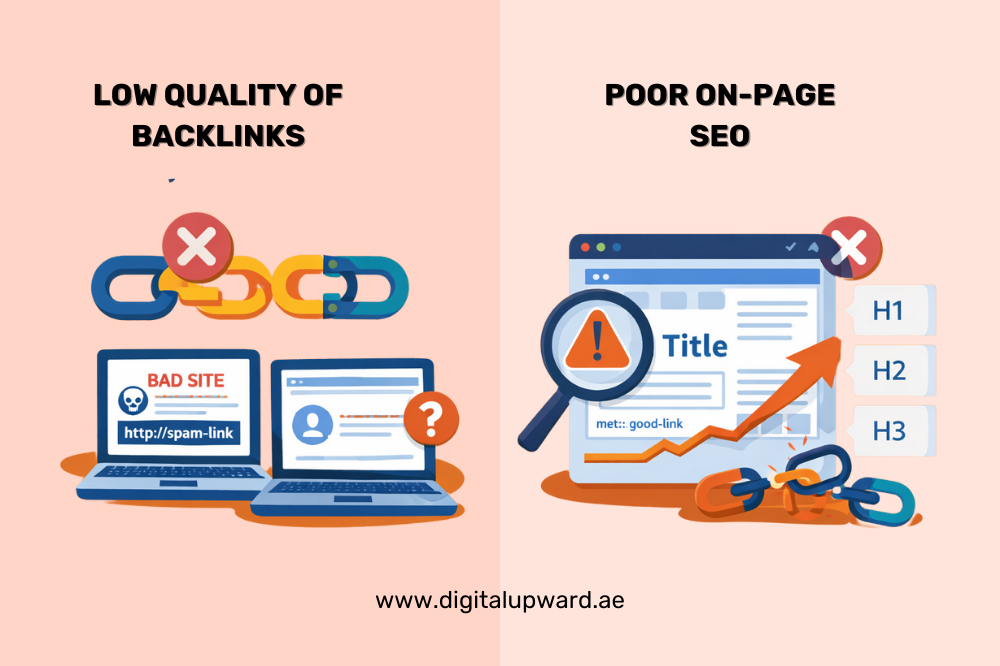
5. Low Quality of Backlinks
Getting backlinks was enough to improve the ranking of the website. However, the quality of the backlinks matters today. Getting backlinks from low-quality websites will not improve the ranking of the website and may even harm the website.
To fix this problem, you need to focus on getting backlinks from quality websites. Creating quality content will help you get backlinks.
6. Poor On-Page SEO
On-page SEO problems are common for many websites. However, these are the basic problems that many business owners are not taking care of. Even if you are providing quality content, these are the factors that will help the search engine understand the content of the website and the importance of the content.
To fix this problem, you need to ensure that
- All the pages of the website have unique title and meta descriptions.
- Use clear headings (H1, H2, H3), and include relevant keywords.
- Use internal links to help the engine crawl and boost your pages.
These are basic steps to help your visibility and user experience.
7. Ignoring Mobile Users
You get more than 50% of your web traffic from mobile devices. If your website does not load well on their smartphones or tablets, they will leave your site immediately, and leave a bad impact on your ranking in Google. This is a huge mistake, especially if you’re in a space which is very competitive. That’s why a lot of companies in Dubai seek help from expert website development company in Dubai to create websites that are responsive and configured perfectly for mobile.
To fix this:
- Design in a way that’s responsive and makes your pages look good on any device.
- Test out your site with Google’s mobile-friendly test tool.
- Apply image compression and reduce the number of such scripts, which can be slowing down your site.
Mobile optimization is critical to SEO in this day and age, affecting user experience, engagement, and even search rankings.
8. Not Tracking and Adjusting
SEO is an ever-evolving process. A lot of businesses make this mistake and eventually fail. SEO isn’t a set-it-and-forget-it process. You need to monitor and track your SEO on a regular basis. If you don’t, your business will suffer.
To fix this:
- Use tools like Google Analytics and Search Console.
- Use parameters such as organic traffic, bounce rate, and keyword rankings.
- Track your SEO with the results of your monitoring.
- With these simple steps, you can improve your SEO step-by-step.
9. Lack of Local Optimization
Local optimization is a key part of modern SEO. For many businesses, local SEO is a major source of traffic and customers. However, many business owners ignore local optimization. Local optimization is a powerful tool to boost your SEO with minimal effort.
To fix this:
- Make sure your business information is accurate on Google Business Profile.
- Add local keywords naturally in your content, meta titles, and meta descriptions.
- Ask for customer reviews and answer them regularly.
Local SEO allows you to get more exposure in the right place.
10. Inconsistent Updates and Competition
The trends and algorithms used by search engines are constantly changing. What used to work for you in 2022 might be outdated and irrelevant in 2026. Businesses that set and forget their SEO strategy are likely to be overtaken by their competition that keeps improving and updating their SEO strategy.
To fix this:
- Get updates on SEO trends and algorithms used by search engines.
- Update old content and ensure that it remains relevant and useful.
- Try out new SEO strategies like using structured data and faster UX improvements.
Constant improvement and updating will ensure that your SEO strategy remains competitive.
Final Thoughts
The process of search engine optimization is complex, and there are many challenges associated with it. Still, the main cause of many problems is the SEO mistakes that are very easily avoidable. Some of the problems are technical SEO issues, no index tags, and broken canonical tags that can stop your site from being ranked. By having the right plan and strategy, you will be able to turn your SEO strategy into a powerful traffic generator for your business.
If you think that you may require the help of a professional in properly implementing these SEO strategies, then why not buy the best SEO services in UAE or get the help of our team of experts at Digital Upward, a leading website development company in Dubai that provides expert SEO services and has a deep understanding of what works and what doesn’t in the modern SEO strategy?
Stay tuned for our next blog, “SEO vs Paid Ads,” where we compare SEO and paid ads and let you know which one is better for your business growth and development.
With effort and proper guidance from experts in SEO strategy and optimization, you can fix what is wrong with your SEO strategy and avoid common SEO mistakes that are holding your business back from reaching its full potential.