
The challenge one has to face while operating an online store is that it is much harder to attract visitors than to build the site. However, when millions of e-commerce sites are striving for a share of the market, being noticed in a search result is important. You don’t have to be a web genius to make your website more visible to the search engines. Let’s look at some common ways of increasing your online store’s search engine optimization (SEO) performance and attracting more customers.
Understanding E-Commerce SEO Basics
Before learning about some specific strategies, we need to get a hold on basic
e-commerce website optimization. It simply means getting your online store product pages to appear at the topmost position of a search engine’s results. When somebody types your product related keywords into Google or another search engine and hits ‘Enter,’ you want their very first page to have your website. Why? Because most buyers these days no longer ever go past that first page.
The basis of good SEO starts with knowing your customers. When searching for your products, what words do they use? Problems are they trying to solve? Answering these questions is going to determine your success.
Start With Your Keyword Research
Building a strong SEO strategy first requires finding the right keywords to target. These are the words and phrases people use when searching for products online. In the case of your e-commerce store, concentrate on product-specific keywords and not general terms.
So instead of ‘shoes,’ use ‘Women’s Leather Ankle Boots: size 7’ or ‘Men’s Waterproof Hiking Boots’; the longer and more specific (“long tail”) the search phrase, the better will be its visibility. These phrases may get fewer searches but they attract people who are ready to buy.
Tools like Google’s Keyword Planning provide free keyword research services while paid alternatives such as SEMrush assist you in discovering what your potential customers are searching for. Look at your competitors’ websites too, they will supply crucial insights into effective keywords in your local industry.
Optimize Your Product Pages
Your product pages are the most important elements on your website. Instead of copying manufacturer descriptions, write unique ones. The search engines discourage duplicate content.
Product Description: No single rule can cover every URL, but keeping them simple and clear will help ensure they make sense to others outside your organization. Your product page URLs should be easy to read. If a search engine and potential buyer can’t understand them, then it would be a problem. A good example of this is for yourstore.com/product12345, it’s far better to use yourstore.com/blue-cotton-summer-dress.
Optimize Images: A website containing too many large and unoptimized images will slow down, and not only can this be harmful to your SEO but it is also a terrible thing for visitors. Compress them without losing quality, use descriptive ‘alt text’ so that both machines and people can understand them best. These exert a definite impact to the overall accessibility of web sites.
Add Customer Reviews: Add reviews that are naturally peppered with keywords used by real clients when discussing your products. In fact good reviews equals hard evidence and new orders.
Improve Your Site Structure
A well-organized website helps both visitors and search engines navigate your store. Along the lines of a pyramid, think of your website structure as having your homepage at the top, category pages in the middle, and product pages at the bottom.
Set up clear category pages that combine related products. For example, shops offering clothing may have three separate areas corresponding to men’s wear, women’s clothes, and childrens dress. These in turn can be split further into more specific items such as T-shirts or trousers instead of all appearing one below another on the same page. Such logical layouts make it easier for search engines to grasp just how your site operates and provide a better utility for users too.
Let every product be within three clicks of your homepage. The better the shop’s accessibility for its products, the more sales.
Speed up your website
Waiting for a slow Web site to load will leave buyers in frustration. Indeed, if your site takes longer than 3 seconds, most of the visitors will move out the door before they’ve even seen any of your products. Site speed is now one of the critical factors which determine a website’s rankings.
Use Google’s PageSpeed Insights tool to test your website’s speed. It will show you exactly what is slowing things down and provide an opportunity to take action without having expensive professionals come in just for this job. Solutions to common problems include compressing images, enabling browser caching or offering advice about which hosting provider might be best suited for you.
Make Your Site Mobile-Friendly
More than 50% of online shopping is done on mobile phones. If you don’t make your site work well with smart phones and tablets, then there is a risk that not only you loose clients but also your Google search rankings! Mobile-first indexing means that Google now uses the mobile version of your site for ranking purposes first and foremost.
- Test your results on various devices to ensure:
- Buttons can be tapped easily, without any problems
- Text is readable without having to zoom in
- Checking out process is simple
In a mobile-first world, a responsive design which adjusts itself as per the screen size is essential.
Provide Valuable Content
Aside from product pages, your e-commerce site should also furnish helpful content that answers customer questions and solves problems. This might be:
- Buying guides, which help clients choose the right product for them
- “How Can I” articles showing different ways to use your products
- Style Guides or trend reports for fashion stores
- Care and maintenance advice on your products
Such content brings in visitors who are not yet ready to purchase, but are researching their options. They can come back to your helpful site when they’re ready to buy. Quality content gives you opportunities to naturally incorporate significant keywords and also to establish your expertise.
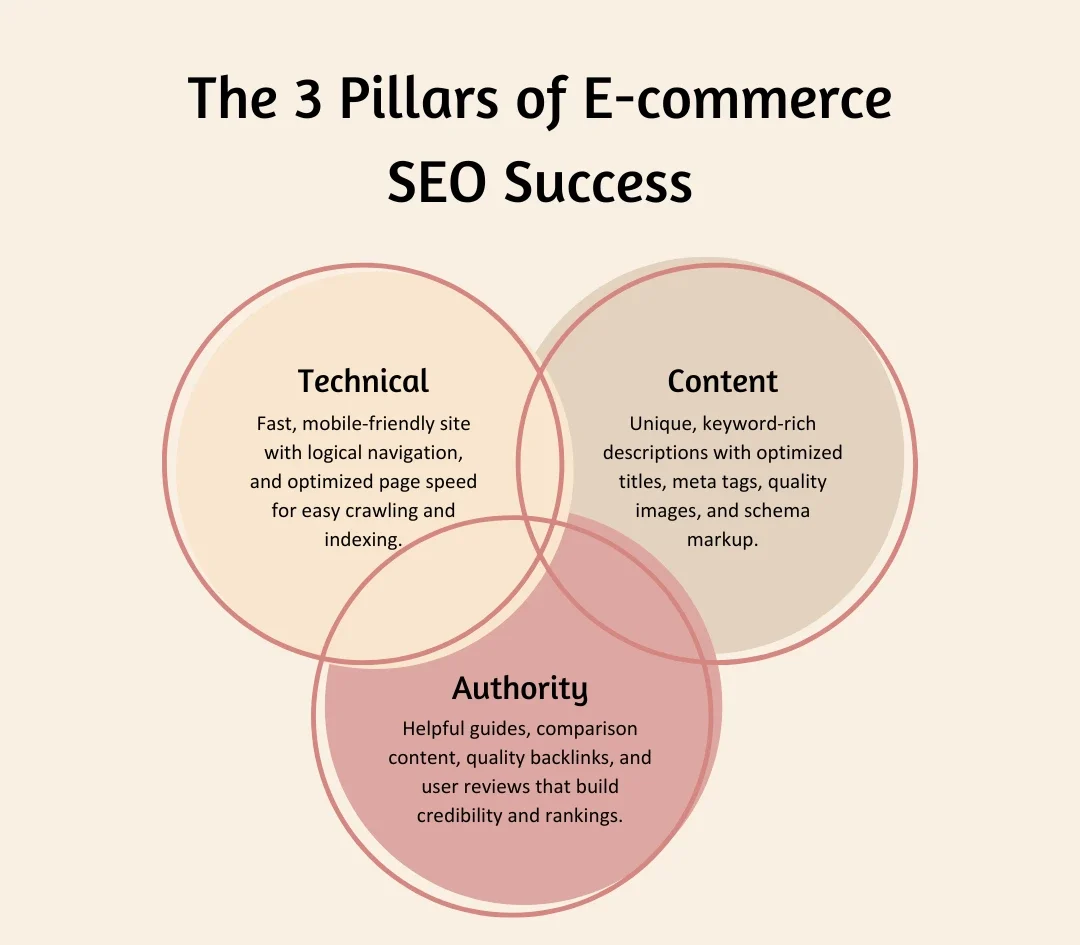
Quality backlink building
Backlinks are references from one website to another. When search engines recognize these connections, they consider them to be good for you. Assuming there is a page on the web that has links to your site, and assuming the text doesn’t include ‘no index’ or ‘nofollow’, each link counts as one vote in favor of your authority. According to this logic, it is clear that pages which have more good quality websites linking to them are considered more authoritative than others.
Ask people in your business who have blogs to review things from your product line. Create content that people want to share and link to. Guest post on related blogs. In addition, cooperation with other companies in similar fields can bring you both some mutual promotional benefits.
Mobilize Local SEO
If you have a brick-and-mortar store, or if your business serves a specific geographical area, then it is imperative for you to do well at local seo. Find your local Google Business Profile and keep it up-to-date with accurate information like address (including landmarks), business hours, phone number etc., photos taken by happy customers in frontline situations without any prompting from yourself but which show how wonderful your product really is. SEO firms in those areas, who are providing the best seo services in UAE, should be addressed as partners since they can provide very useful feedback on the search habits of people from that region and how you can approach them. They understand what constraints are unique to local markets and what opportunities these may provide
Importance of Technical SEO
While content and keywords are important, technical issues on your website affect how search engines crawl and index your web pages. To ensure all your important pages are indexed, they are listed in an XML sitemap. A file (robot.txt) is added that tells search engines what to crawl, and what not to crawl. Secure encryption of data so customers’ directives are protected from hackers. A schema markup that helps search engines understand the information about your products
These technical aspects might sound daunting, but many e-commerce platforms automatically deal with them for you. If you’re still uncertain, speak to a techie or ask for direct professional help. Choosing the right platform plays a key role in SEO performance—this blog explains how to choose the best website builder for small businesses in the UAE.
Monitor and Adjust
SEO in E-commerce is not a simple one-time task. It requires continuous attention and updates. Make good use of Google Analytics and Google Search Console to monitor the performance of your site. Pay attention to what keywords bring in traffic, which pages do best, and where people are leaving.
However, it is not necessary to handle SEO yourself for small businesses. You can even turn to digital marketing services in Dubai or in other locations for advice and guidance on search engine optimization for e-commerce. These people keep up with the latest changes in algorithms, saving both time and money.
Conclusion
It shouldn’t be too difficult to improve your e-commerce site’s SEO performance. Start with the basics, such as good keyword research, solid product pages, good site speed, and mobile-friendly design. Then, you will have to create top-notch content. Pick up some quality link-backs. Finally, start tracking how well you are doing.
The digital marketplace is hard-fought indeed, but with the right SEO approach, our professional team at Digital Upward ensures that your e-commerce web site not only can survive in today’s environment but rise above all the noise and reach new buyers. Start using these strategies today, and see your online footprint as well as your profits grow.